

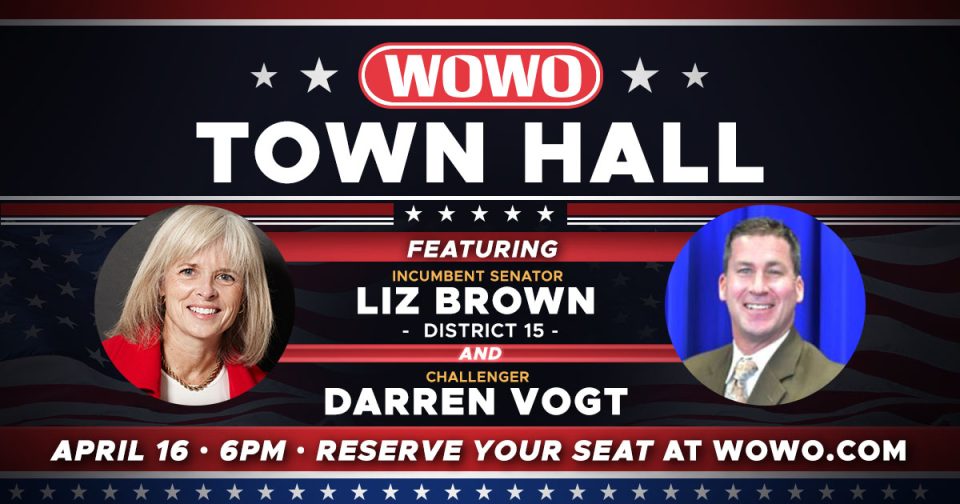
FORT WAYNE, IND. (WOWO) WOWO’S Town Hall Debate between incumbent District 15 Senator Liz Brown and Darren Vogt was held at The Mic – WOWO’s new broadcast center, and hosted by Kayla Blakeslee.
Taxes and Cost of Living
The first question immediately zeroes in on economic frustration, citing “some of the nation’s highest gas taxes… and property tax bills [that] have dramatically raised” while asking why lawmakers focus on social issues instead.
Brown acknowledges the concern directly: “Property taxes are the biggest… tax bill that people get, and that is a concern.” But she shifts responsibility, stressing, “property taxes are collected at the local level… they’re the ones who decide what the rate’s going to be.” She admits, “We didn’t get the job done completely… but we can do more.”
Vogt takes a different approach, focusing less on structure and more on action. He criticizes automatic increases: “The gas tax goes up every April, no matter what… I will not vote for automatic increases.” He introduces his central idea: “what I call the Great Hoosier Audit,” arguing even “1% is $220 million of the state budget” that could be recovered from “waste, fraud, and abuse.”
A brief clash follows when Brown points to a school referendum Vogt supported that could raise taxes, while Vogt fires back, “she was actually critical for us to get that through… and I’ve got the receipts.”
Term Limits and Experience
On term limits, Brown openly revisits her past stance: “I thought I could get the job done in eight years.” Experience changed that view. She explains, “It takes a long time… to figure out how to get good bills passed,” noting some legislation took “two years” or even “three years” to succeed.
Vogt responds bluntly: “I will not make a promise… of serving two terms and then run for a fourth term.” He adds, “there’s a time when you’re not effective anymore,” arguing government should remain “of the people, by the people, and for the people.”
The contrast is clear—Brown argues effectiveness grows with time; Vogt warns it can fade.
Property Taxes and Schools
A resident asks why they pay school taxes without children in school. Vogt answers with a broader economic lens: “A strong school system supports your property values… if you have a poor or failing school system, you’re just going to see your property values go down.”
Brown counters with a more personal reality: “I haven’t met anyone… who says, I’m so happy the value of my home has increased so I get to pay more taxes.” She highlights seniors in particular: “I’ve paid for my home, but I’m still paying it off because of property taxes.”
She also criticizes school spending, warning against referendums funding “natatoriums and things like that.” Vogt quickly rebuts: “That was never in Northwest Allen County Schools’ referendum… nothing about a pool whatsoever.”
School Policy and Cultural Issues
Tensions peak during a question about school bathrooms. Vogt frames the issue simply: “We have single stall bathrooms… a boy can’t come into a girl’s bathroom, plain and simple.” He compares it to a household setup, emphasizing practicality and safety.
Brown challenges that characterization sharply: “Having a door and a toilet is not a single sex bathroom.” She argues the design includes “open corridor” layouts, raising privacy concerns about shared spaces.
Vogt pushes back strongly, even offering evidence: “260-402-1835… I want you to see a picture of these bathrooms,” insisting, “please, make sure you get the facts.”
The exchange becomes one of the most direct confrontations of the night, shifting from policy to credibility.
State vs Local Control (SB1)
A question about Senate Bill 1 raises concerns about state overreach. Brown defends intervention, arguing local governments have failed to act: “No units of government seem to get the message that locals are tired of paying increasing property taxes.” She adds bluntly, “the state is gonna come in heavy-handed this session.”
She describes a pattern: when limits are proposed, local leaders “immediately say, we’re gonna cut fire and police,” rather than reduce spending elsewhere.
Vogt criticizes that approach, calling SB1 “a top-down approach without collaboration.” He argues for partnership instead: “let’s sit down at the table… and figure out what can we cut.” His solution again returns to audits and cooperation rather than mandates.
Other Issues: Agriculture, Public Safety, Healthcare
On agriculture, Brown highlights her record and support from industry groups, emphasizing efforts to protect farmland and reduce burdens like equipment taxes. Vogt takes a more consultative tone: “I’m not a farmer… I will look to those like you,” stressing the importance of listening to industry leaders.
On maternal health, Brown ties policy to her pro-life stance, noting expanded support: “we extended the postpartum coverage… up to a year,” and added resources for mothers and infants.
On public safety, she defends her record against criticism, clarifying a controversial vote by saying the original bill conflicted with “our First Amendment fundamental rights,” but that she later supported a corrected version.
