

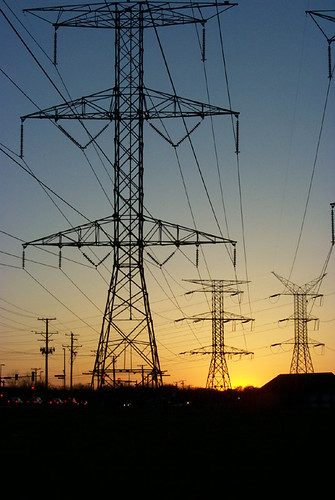
INDIANAPOLIS, Ind. (WOWO) — Indiana is receiving $175 million in federal funding to upgrade a critical electricity transmission connection between two regional power grids, a project officials say could increase the amount of electricity moving through the state while reducing congestion and potentially lowering costs for ratepayers.
The funding was announced Thursday at the Indiana Statehouse by U.S. Department of Energy General Counsel Jonathan Brightbill as part of more than $1.9 billion in federal grants awarded to 31 transmission projects nationwide.
The Indiana project will target what Gov. Mike Braun described as a regional electricity “pinch point” or “choke point” where the Midcontinent Independent System Operator, known as MISO, meets the PJM Interconnection.
That regional boundary crosses portions of Illinois, Indiana, Michigan and Kentucky.
“The challenge isn’t simply generating more electricity,” Brightbill said. “It’s making the grid so that it can move power where it is needed quickly, affordably, and reliably across one of the most important regional seams in the country — and that comes and lands right here in Indiana.”
Officials estimate the four-year Indiana project could unlock between 2,000 and 4,000 megawatts of additional transfer capacity at the state’s interconnection.
The project is expected to reduce congestion and save ratepayers in Indiana and elsewhere between $50 million and $150 million each year, according to federal officials.
Brightbill said congestion can prevent available electricity generation from reaching areas where it is needed. That can contribute to localized price increases when electricity supplies become constrained.
“Congestion, that may cut off access to generation that’s available,” Brightbill said. “The way the bulk power system works, you end up with pockets. And then with dynamic pricing … you can end up with prices spiking in localized areas that then will cost those local ratepayers a lot of money.”
The Indiana project will include replacing aging transmission lines with newer materials designed to carry electricity more efficiently.
Grid operators also will gain access to technology that can dynamically assess transmission lines based on current weather conditions. Traditional static ratings generally account for more conservative, worst-case conditions, while dynamic assessments can allow lines to carry additional electricity when conditions are favorable.
The project also calls for topographic software that can help grid operators identify more efficient routes for moving electricity from lower-cost sources to areas where power is needed.
The federal grant will cover $175 million of the project’s cost. Project sponsors are expected to contribute another $150 million, bringing the total investment to approximately $325 million.
Brightbill said the national transmission initiative will involve rebuilding or reconductoring more than 1,500 miles of transmission infrastructure and deploying grid-enhancing technology across nearly 21,000 miles of transmission lines.
Together, the projects are expected to increase grid capacity by more than 23 gigawatts.
The federal funding was authorized through the 2021 Bipartisan Infrastructure Law. The program was originally known as the Grid Resilience and Innovation Partnerships program.
The Trump administration has renamed the initiative SPARK, short for Speed to Power through Accelerated Reconductoring and other Key Advanced Transmission Technology Upgrades.
Indiana officials also announced Thursday that the state is taking over federal responsibilities for regulating certain radioactive materials used for medical, industrial, academic and fusion-related purposes.
The agreement makes Indiana the 41st state to become an agreement state under the federal Atomic Energy Act.
Under the arrangement, the U.S. Nuclear Regulatory Commission is transferring regulatory authority over certain non-energy nuclear materials to Indiana. The federal government will continue to oversee commercial nuclear power reactors, research reactors and nuclear fuel-cycle facilities.
The transition has been several years in the making. Then-Gov. Eric Holcomb submitted Indiana’s letter of intent to pursue agreement-state status in 2021.
The Indiana Department of Homeland Security will administer the state’s new regulatory program.
Agency spokeswoman Ashley Morgan said five health physicists will handle licensing and inspections.
The program will be funded largely through licensing fees. A state fee schedule includes charges, mostly in the thousands of dollars, depending on the type of radioactive-material license involved.
Indiana’s Department of Homeland Security already operates a radiation team responsible for nuclear emergency response and radiation risks. The agency also works with communities considering nuclear-related development in coordination with the Indiana Office of Energy Development.
Braun said bringing more permitting and licensing decisions under state control will give Indiana greater authority over its energy policy.
“Making more licensing and permitting decisions here in Indiana rather than in Washington means Hoosiers have more control over Indiana’s energy future,” Braun said. He called the agreement a necessary step toward the state’s nuclear energy goals.
Indiana currently has no operating nuclear power plants, but Braun and other state officials have made nuclear development a major part of their long-term energy strategy.
NRC Chairman Ho Nieh said the federal agency also intends to move more quickly on nuclear reactor applications under the Trump administration.
“If Indiana and companies in Indiana want to pursue nuclear energy, I can assure you that the NRC will not be an impediment,” Nieh said.
Nieh said the NRC intends to maintain its safety responsibilities while speeding up regulatory reviews. He said the agency plans to approve applications for first-of-a-kind reactors within 18 months or less and applications involving repeat reactor designs within a year or less.
The two announcements put transmission infrastructure and nuclear development at the center of Indiana’s energy agenda, with state and federal officials emphasizing faster movement of electricity, expanded grid capacity and increased state involvement in radioactive-material regulation.
