

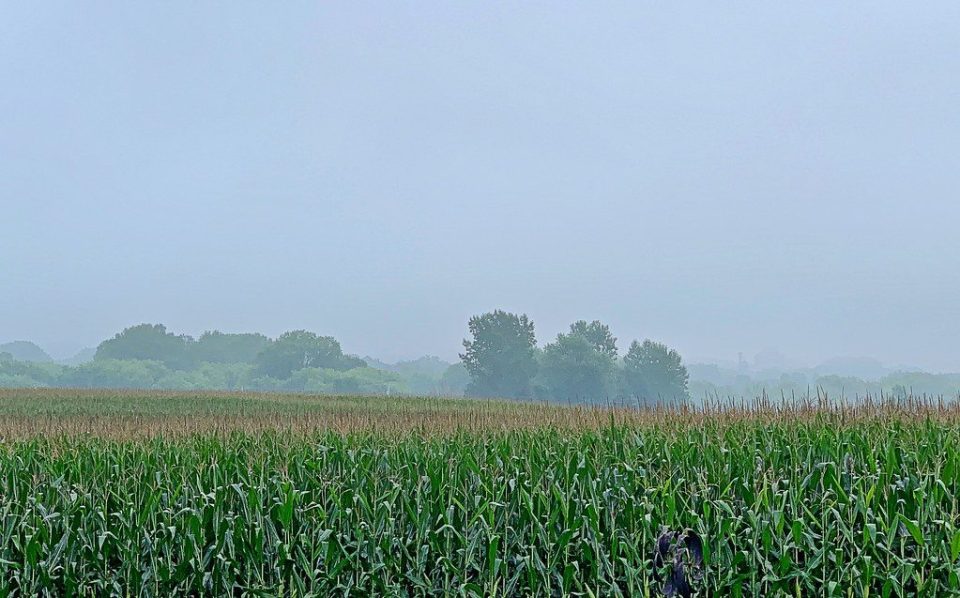
LANSING, Mich. (WOWO) — Michigan environmental officials are defending the state’s air quality monitoring network as environmental advocates argue more monitoring sites and funding are needed to give residents a clearer picture of the air they’re breathing during increasingly frequent wildfire smoke events.
The debate follows an unusually heavy summer of wildfire smoke from Canada that pushed air quality concerns to the forefront across Michigan and led to numerous air quality alerts.
Michigan currently operates 45 air monitoring sites statewide, but just two are located in the Upper Peninsula.
Environmental advocates say that distribution can leave significant gaps, particularly during wildfire smoke events when air conditions can change rapidly from one community to another.
“Accuracy is key here, especially when we have these events. They are no longer something that is exceptional; they are something that is ongoing,” said Samantha Pickering of the Michigan Environmental Council.
Pickering said an individual monitoring station can accurately measure conditions where it is located, but that measurement does not necessarily capture changes in air quality in nearby communities.
“The monitor in a certain space will represent the conditions at that particular location, but it doesn’t necessarily capture every variation in air quality and how things are happening at a more localized level,” Pickering said.
That concern is particularly relevant when wildfire smoke moves into Michigan from Canada according to News10 Lansing.
“Pollution knows no boundaries. It’s not going to stop at the boundary line of Canada and Michigan; it’s just going to come through,” Pickering said.
The Michigan Department of Environment, Great Lakes and Energy, or EGLE, says the state’s monitoring network meets and exceeds federal requirements established by the U.S. Environmental Protection Agency.
Erica Wolf with EGLE said Michigan has exceeded federal air monitoring regulations for more than a decade and defended the accuracy of the information being provided to the public.
“Looking at how our forecasters have forecasted air monitoring in the past, based on our current network, I don’t see that there is an actual gap there,” Wolf said.
Wolf also said federal rules do not require Michigan to maintain an air monitor in the Upper Peninsula.
She said residents do not necessarily need to live immediately next to a monitoring station to get useful information about local air conditions.
“So you don’t have to have a monitor right in front of you to know what the air quality is. You just have to be somewhere around an air monitor, like within 15-20 miles is considered pretty close to a system,” Wolf said.
Michigan also does not rely exclusively on monitors within its own borders.
Wolf said neighboring states have their own monitoring networks and that information from those systems can be used along with Michigan’s data to help forecasters develop a broader picture of air quality conditions.
The disagreement is not centered only on whether the existing monitors are functioning properly. Advocates say the issue is whether the network is extensive enough to capture highly localized differences in pollution and smoke concentrations.
Pickering said additional funding could help expand Michigan’s monitoring capabilities, but she also wants the state to be strategic about where new equipment is placed if additional money becomes available.
For residents dealing with wildfire smoke, the issue can be particularly important because air quality can fluctuate considerably depending on location and weather conditions.
Smoke from Canadian wildfires became a major public health and environmental concern across the Great Lakes region this summer, making air quality forecasts and monitoring information an increasingly important tool for residents deciding whether to spend time outdoors.
EGLE is planning to expand the state’s monitoring network with two additional sites in Detroit and another in Lansing.
There are currently no plans to add monitoring locations in the Upper Peninsula.
That leaves environmental advocates continuing to call for more coverage in parts of the state where they say residents may not have access to the same level of localized air quality information.
State officials, meanwhile, maintain that Michigan’s existing network, combined with monitoring information from surrounding states and forecasting tools, provides sufficient data to track air quality and issue warnings when conditions deteriorate.
The debate comes as wildfire smoke becomes a recurring concern rather than an unusual event, raising broader questions about whether air monitoring systems designed under existing federal standards are keeping pace with changing environmental conditions.
For Michigan residents, particularly those vulnerable to poor air quality, the competing views highlight the importance of paying attention to official air quality alerts while the state considers where and how to expand its monitoring network.
