

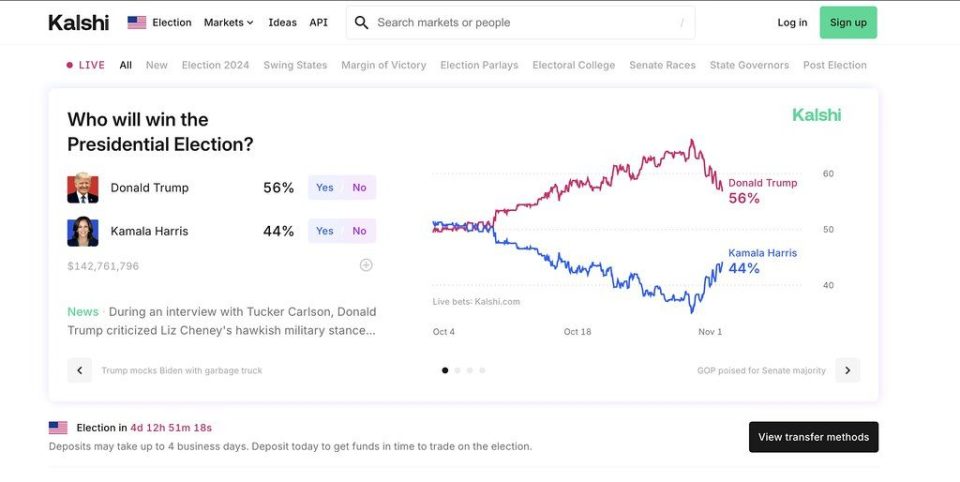
COLUMBUS, Ohio (WOWO) — Ohio Gov. Mike DeWine says the state will move to hold prediction-market company Kalshi accountable after a federal appeals court ruled Ohio can enforce its sports-gambling laws against the company.
The U.S. Sixth Circuit Court of Appeals ruled Friday that Kalshi’s sports-event contracts are not protected from state gambling regulations by federal commodities law.
The unanimous ruling affirmed an Ohio federal district court’s decision that denied Kalshi’s request to block enforcement of Ohio’s gambling laws. The appeals court also overturned a preliminary injunction that had been granted to Kalshi in a separate Tennessee case.
The ruling could have broader implications for the rapidly expanding prediction-market industry, which has argued that its event contracts are financial products regulated by the federal Commodity Futures Trading Commission rather than sports wagers regulated by individual states.
DeWine said Monday that Ohio will enforce its existing laws according to the Ohio Capital Journal.
“These so-called prediction markets, which are really gambling, nothing more than that, they’re just trying to get around the law, don’t want to play by the same rules everybody else does,” DeWine said.
The dispute centers on how Kalshi’s sports contracts are classified.
Kalshi operates a federally regulated derivatives exchange where users can buy and sell what the company calls event contracts. Those contracts allow customers to take a “yes” or “no” position on whether a particular event will occur.
Sports-related contracts can involve the outcome of games, individual events during games or other sporting results.
Kalshi has argued that those contracts are financial derivatives, or swaps, subject to the exclusive jurisdiction of the Commodity Futures Trading Commission.
Ohio regulators have taken a different position, saying Kalshi’s sports contracts amount to sports wagering and therefore fall under Ohio’s sports-gaming laws.
The Sixth Circuit sided with Ohio and Tennessee on the central issue in the case.
Judge Julia Smith Gibbons wrote that Kalshi had not demonstrated that its sports-event contracts meet the federal statutory definition of a “swap.”
The court also said that even if the contracts qualified as swaps, Kalshi had not shown that the federal Commodity Exchange Act prevents Ohio and Tennessee from enforcing their gambling laws.
The ruling leaves Kalshi subject to state regulation in Ohio and Tennessee while the broader legal fight over prediction markets continues.
Ohio’s Casino Control Commission previously sent Kalshi a cease-and-desist letter, arguing the company was offering sports gaming in Ohio without the required license.
The commission also raised concerns about the availability of Kalshi’s sports contracts to people under Ohio’s legal gambling age.
Ohio law requires people to be at least 21 to participate in sports gaming.
Kalshi challenged the state’s position in federal court, arguing that its federal regulatory status prevented Ohio from applying its sports-gambling laws.
The federal appeals court rejected that argument at the preliminary-injunction stage.
The court’s decision does not mean every legal question surrounding Kalshi has been permanently resolved. The case was sent back to the lower courts for further proceedings.
Kalshi has also indicated it plans to continue fighting the ruling.
“We disagree with this decision and don’t believe it will survive further review,” Kalshi spokesperson Dani Lever said.
Lever argued that the federal regulatory framework was designed to provide nationwide oversight of the company’s markets.
“Markets can’t operate when the rules change at every state line, which is why Congress created a single federal regulator with nationwide rules,” Lever said.
The legal dispute is significant because prediction markets have expanded into areas traditionally associated with sportsbooks.
Kalshi allows customers to trade contracts involving sports as well as subjects including politics, economics, entertainment and other events.
The company has described its products as event contracts rather than conventional sports bets.
The Sixth Circuit, however, focused specifically on the sports contracts at issue in the Ohio and Tennessee cases.
The court noted that Kalshi had marketed itself as a nationwide sports betting platform while simultaneously arguing that its products were outside state gambling regulations.
The ruling also contributes to an emerging split among federal appeals courts over how prediction markets should be regulated.
Different federal courts have reached different conclusions involving similar questions, leaving the possibility of additional appeals and potentially Supreme Court review.
For Ohio, the immediate issue is whether Kalshi must comply with the same state sports-gambling requirements that apply to licensed sportsbooks.
Those requirements include obtaining a state license and complying with regulations governing sports wagering.
Ohio also imposes a tax on sports gaming revenue.
DeWine said Kalshi should not be allowed to operate under a different set of rules than companies that have gone through Ohio’s licensing process.
He said the state has lost potential revenue while Kalshi has operated without complying with those requirements.
“They just wanna have a free ride,” DeWine said. “We will certainly enforce the law.”
The Ohio sports-gaming framework includes licensing requirements and restrictions designed to regulate operators and protect consumers.
The state has also established a minimum age of 21 for sports wagering.
Kalshi has argued in court that requiring it to comply with Ohio’s regulatory framework could threaten the viability of its business model.
The company maintains that its federally regulated exchange should be governed under federal commodities law rather than separate state gambling laws.
The Sixth Circuit’s ruling rejects that position for the sports-event contracts at issue in Ohio and Tennessee, at least at this stage of the litigation.
The decision could also affect other companies offering prediction-market products tied to sporting events, as states continue to determine whether those products should be treated as financial contracts or gambling.
The issue is likely to remain unsettled nationally as courts consider conflicting arguments over the division of authority between federal regulators and state gambling authorities.
For now, Ohio regulators have the federal appeals court’s decision supporting their authority to enforce the state’s sports-gambling laws against Kalshi.
DeWine says the state intends to use that authority.
As of Monday evening, Kalshi’s website had not made changes to its Ohio operations to comply with the state’s sports-gambling requirements.
