

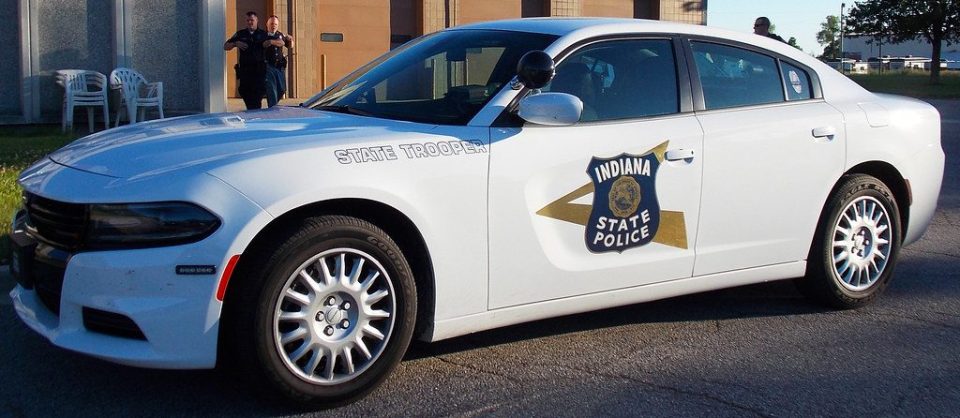
INDIANAPOLIS, Ind. (WOWO) — Indiana State Police is seeking roughly $30 million in federal funding for new vehicles, surveillance equipment and investigative technology that the agency says would strengthen law enforcement statewide, including its existing work with federal immigration authorities.
ISP applied in July for funding through the U.S. Department of Justice’s fiscal year 2026 Bridging Immigration-Related Deficits Experienced Nationwide program, known as BIDEN according to the Indiana Capital Chronicle.
The $3 billion federal program was created by Congress through President Donald Trump’s One Big Beautiful Bill Act and provides funding to state and local law enforcement agencies participating in, or committing to participate in, the federal government’s 287(g) immigration enforcement program.
The 287(g) program allows participating state and local officers, under federal supervision, to perform certain immigration enforcement functions.
According to documents submitted to the Indiana State Budget Committee, ISP listed a federal funding request of $29,069,985. A revised budget and federal application included in the same 33-page submission put the total request at $30,269,985.
ISP spokesperson Sgt. John Perrine said the application remained pending as of September 8 and that the Justice Department had not announced which agencies would receive funding.
The request does not call for state or local matching money, and ISP says it would not add employees as part of the proposal.
The agency says the equipment would be used for a wide range of investigations, including drug trafficking, human trafficking, organized crime, violent crime, child exploitation, fugitive investigations and forensic work.
But immigration enforcement is also a specific part of the application.
ISP said one objective of the proposal is to “increase the quality, speed, and consistency of immigration-related enforcement support while maintaining proper vetting, documentation, and supervision.”
The agency reported that 185 state police troopers had been trained and certified by U.S. Immigration and Customs Enforcement under Indiana’s 287(g) agreement as of July.
Perrine said that number had increased to 217 by September 8.
The participating troopers include road officers, detectives, interdiction personnel, narcotics investigators and commercial motor vehicle enforcement officers.
ISP’s application said its personnel had participated in 276 detainments under the 287(g) agreement as of July. Certified troopers are required to participate in at least two enforcement efforts with ICE each quarter, according to the application.
The state police also said its Intelligence Fusion Center has been receiving and reviewing immigration-related tips before forwarding vetted information to federal agencies.
The application said the center had received 604 immigration-related tips. Of those, 573 involved individuals, 14 involved Indiana Department of Correction parolees, 14 concerned addresses and three involved businesses.
“Those figures show a sustained and growing federal-support workload that requires trained personnel, reliable technology, and coordinated statewide intelligence capacity,” ISP officials wrote in the application.
The proposed federal money would build on an existing relationship between Indiana law enforcement and federal immigration authorities.
An executive order issued by Gov. Mike Braun in 2025 directs state law enforcement agencies to cooperate with ICE to the maximum extent permitted by law, including entering agreements that allow officers to perform certain federal immigration functions.
ISP described its need for the federal funding as “immediate and statewide.”
The agency said the grant would help maintain and expand its participation in the 287(g) program, federal task force activities and its process for screening immigration-related tips.
Perrine said the equipment would not be limited to immigration enforcement.
“All the equipment and supplies obtained through this opportunity will augment enforcement efforts in every segment of public safety regardless of crime or threat,” Perrine said. “This includes immigration enforcement. Better trained, better equipped troopers will benefit all Indiana communities.”
The largest portion of the proposed budget would go toward equipment.
The revised application allocates about $21.6 million for equipment, approximately $6.8 million for technology and other contractual expenses, $1.2 million for construction or renovations, about $476,000 for supplies and $204,200 for travel and training.
The proposal includes $10.56 million for 176 vehicles, with each vehicle budgeted at $60,000.
ISP says those vehicles would replace or expand its existing fleet and would include both marked and unmarked vehicles used by investigators and troopers.
The agency says the vehicles would be shared throughout the department rather than assigned specifically to immigration enforcement.
The proposed purchases also include covert surveillance cameras, license-plate and vehicle-identification technology, cellular-location equipment, armored vehicles, drones, firearms, ballistic vehicle upgrades, protective equipment, K-9 resources and forensic technology.
The revised budget includes approximately $1.42 million for 20 covert camera systems.
ISP says those systems would allow a limited number of investigators to monitor multiple locations and preserve recorded information for investigations and potential prosecutions.
The agency says its current covert-camera infrastructure is aging and that its mobile surveillance capabilities are limited. According to the grant application, those limitations can delay deployments during time-sensitive investigations.
ISP is also seeking $3 million for three years of an investigative platform used to process cellphone information and court-order data.
The agency says the platform can assist investigators in identifying people, addresses and vehicles and in examining financial activity, cryptocurrency transactions and connections between individuals or organizations.
The application also calls for five cell-site simulator systems at a combined cost of $1.5 million.
Another $570,000 would be used for 10 portable cell-site simulator backpacks.
The agency wants to spend another $300,000 on 20 license-plate camera systems.
ISP says the surveillance and location technology could be used in investigations involving drug trafficking, human trafficking, organized crime and immigration-related cases.
The application does not specify what percentage of the equipment would be dedicated specifically to immigration enforcement.
Perrine said some of the technology has restrictions on its use.
He noted that court authorization is required to obtain cellular-location records.
ISP policy also requires a legitimate law enforcement purpose and documented inquiry before officers can search license-plate reader information. The data is generally deleted after 30 days unless it is preserved as part of an investigation.
The agency’s Intelligence Fusion Center can share information with authorized government or private-sector personnel for official public safety or justice purposes, while maintaining an audit trail of the activity.
The grant application has also drawn criticism from an immigration advocacy organization.
Cole Varga, CEO of Indianapolis-based Exodus Refugee Immigration, said the application’s emphasis on maintaining and expanding federal partnerships suggests immigration enforcement could play a larger role in the proposal than ISP’s broader public-safety description indicates.
“They are downplaying their involvement but they are indeed involved,” Varga told the Indiana Capital Chronicle.
Varga also questioned ISP’s statement that the grant would not require additional employees.
He argued that while federal money would not directly pay for new personnel, funding equipment through the grant could free up state dollars for other purposes, including immigration enforcement.
“But, that ISP claims there will not be staffing connected to this agreement is misleading,” Varga said. “If you are subsidizing other parts of your annual budget with equipment, that frees up other funds to spend on ICE cooperation.”
The application itself does not identify new positions.
ISP says existing employees would handle the work and that no outside agencies would receive grant funds directly. Other law enforcement agencies could participate through existing task forces and partnerships.
Varga also cited reports of ISP involvement in immigration arrests in South Bend and other parts of Indiana and called for greater scrutiny of the agency’s coordination with federal immigration authorities.
Perrine said ISP works with other law enforcement agencies “in the furtherance of our mission and to protect every citizen in Indiana.”
When asked whether accepting the federal grant would create new immigration enforcement responsibilities for the state police, Perrine said ISP “will continue to support the enforcement efforts of our federal law enforcement partners.”
The size of the request has also raised questions about state oversight.
Despite the nearly $30 million price tag, ISP’s application did not require advance approval from the Indiana State Budget Committee.
A state law that took effect in 2025 requires state agencies to report requests for new federal funding on a quarterly basis.
However, the law does not require committee review before an agency accepts federal funding when the grant does not require a state match, does not create additional permanent full-time positions and does not impose new requirements on Indiana.
ISP reported no state, local or third-party matching funds, no new employees and no additional requirements “at this time.”
The law requires agencies to disclose the amount of federal funding requested, any new state spending or employees, conditions attached to the money and the federal application.
It does not give the Budget Committee approval authority over grants that meet the exception.
