

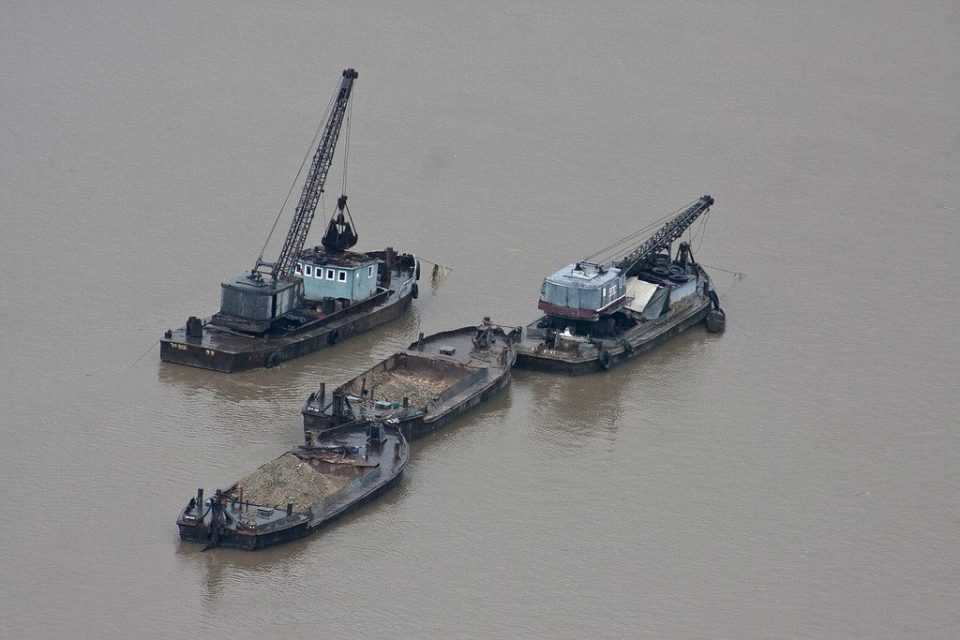
TOLEDO, Ohio (WOWO) — The largest annual dredging operation on the Great Lakes is set to begin in Toledo Harbor next month, with crews expected to remove roughly 750,000 cubic yards of sediment from the Maumee River’s federal navigation channel.
The U.S. Army Corps of Engineers’ Buffalo District and Michigan-based Ryba Marine Construction Company will carry out the work beginning in September. The project is expected to continue through December according to WTVG.
The $11.1 million project is structured as a two-year contract and covers the full length of the federal navigation channel, from the turning basin upstream on the Maumee River to the mouth of the river at Maumee Bay.
The first year of the contract is being funded through a $5.3 million task order issued August 6. A second task order, valued at about $5.8 million, is expected in 2027.
The Corps says maintaining the channel is critical to keeping large commercial vessels moving in and out of Toledo Harbor and maintaining the flow of commodities through the Great Lakes.
“Maintaining the operation of ports like Toledo is a core part of our mission and essential to more than $1 billion in annual economic impact,” said Lt. Col. Aaron Anderson, commander of the Buffalo District.
“As the largest single dredging operation on the Great Lakes, our work here does more than just clear a navigation channel – it sustains people’s livelihoods, supports their communities, and powers the regional and national economy,” Anderson said.
Toledo Harbor handles about 11 million tons of cargo each year and supports an estimated 2,822 jobs, according to the project information provided by the Corps.
The dredging is part of the routine maintenance required to keep the federal navigation channel at usable depths.
The Army Corps has previously described Toledo Harbor as the largest dredging operation on the Great Lakes because of the amount of material that must be removed to maintain its navigation channel. In a 2025 announcement, the Corps said Toledo’s channel requires more dredged material to be removed than any other Great Lakes harbor.
The work is concentrated along the Maumee River and its approach into Lake Erie, an area where sediment naturally accumulates and can reduce the depth available to commercial vessels.
Without regular maintenance dredging, those deposits can restrict navigation and potentially limit the size or amount of cargo vessels can carry.
The Corps has conducted Toledo Harbor dredging on an annual basis when the work is needed and funding is available. Previous projects have involved hundreds of thousands of cubic yards of sediment being mechanically removed from the navigation channel.
The material removed during this year’s project will not simply be dumped into the lake.
Instead, it will be placed in confined disposal facilities operated by the U.S. Army Corps of Engineers and the Toledo-Lucas County Port Authority.
Those facilities are designed to contain dredged sediment removed from the navigation channel.
The approach also reflects a broader effort in recent Toledo dredging projects to manage sediment in confined facilities rather than relying on open-lake disposal. The Corps’ 2025 Toledo project, for example, called for dredged material to be placed in the Toledo-Lucas County Port Authority’s confined disposal facility.
The economic stakes are significant for Toledo and the surrounding region.
The harbor serves as a major transportation point for bulk commodities moving through the Great Lakes, connecting businesses in northwest Ohio and beyond with the broader Great Lakes shipping network.
The Corps has previously said Toledo Harbor’s waterborne transportation activity supports hundreds of millions of dollars in business revenue and thousands of jobs.
The upcoming project also comes as Toledo continues to rely on its harbor as a major component of the region’s industrial and transportation economy.
The 2026 dredging operation is scheduled to get underway in September and continue through December, weather and operating conditions permitting.
The first-year task order represents nearly half of the total two-year contract. Another task order is expected next year to continue the maintenance work.
For the Army Corps of Engineers, the project is about more than removing sediment from the river bottom.
Keeping the federal navigation channel open and at the required depth allows commercial ships to reach Toledo, helps maintain the movement of cargo and supports the businesses and workers who depend on the port.
With roughly three-quarters of a million cubic yards of material scheduled for removal this year, Toledo Harbor will once again be the site of the largest annual dredging operation on the Great Lakes.
