

DETROIT, Mich. (WOWO)— Michigan has dozens of official air-quality monitoring sites, but large portions of the state remain far from a monitor — a gap environmental and public-health experts say can leave residents without reliable, localized information during wildfire smoke events and other pollution episodes.
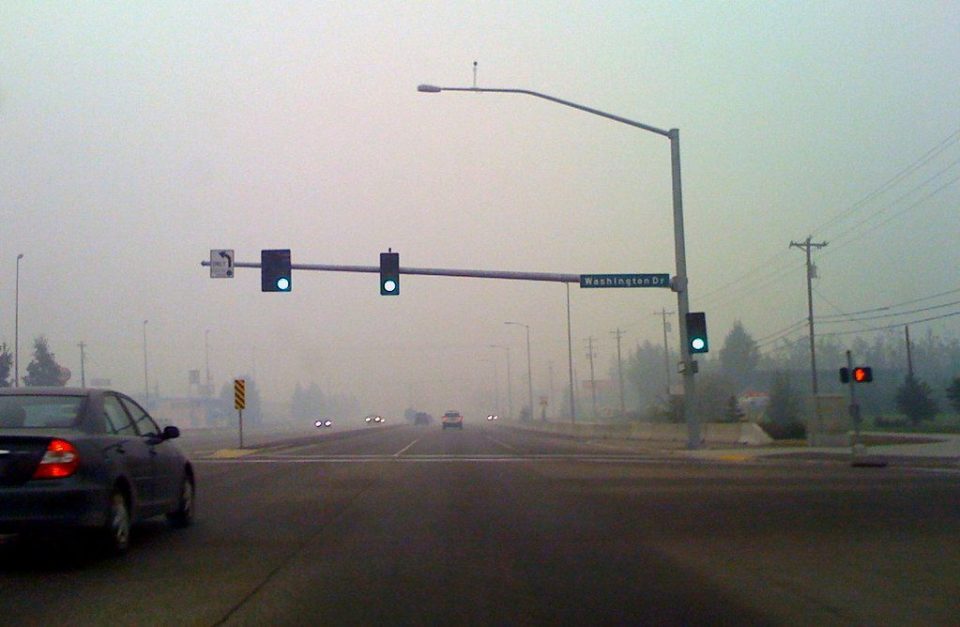
The issue drew renewed attention this summer when smoke from wildfires in Canada and Minnesota spread across Michigan. Air-quality readings in some parts of the state soared to levels considered hazardous, while residents in areas without nearby monitors had limited information about conditions where they actually lived.
A report by Bridge Michigan found Michigan operates 45 air-quality monitoring sites across roughly 58,000 square miles. Only two are located in the Upper Peninsula, while the northern Lower Peninsula has no monitoring sites north of Frankfort, according to the report.
That means some monitors are separated by hundreds of miles, and experts caution that an official reading from one location may not accurately represent conditions in another.
The concern extends beyond wildfire smoke. Air pollution can come from industrial facilities, agriculture, ozone and fine particulate matter, meaning communities without nearby monitoring may have less information about their exposure to potentially harmful pollutants.
“We should feel confident knowing that the air we breathe every day won’t make us sick,” Debbie Chizewer, managing attorney with environmental law organization Earthjustice, told Bridge Michigan.
Chizewer said studies have linked exposure to toxic air pollution with increased risks of asthma, heart disease and cancer, adding that without adequate monitoring, it can be difficult to determine what people are breathing or enforce air-quality protections.
Michigan officials, however, say the state is meeting federal requirements.
Josef Stephens, a spokesperson for the Michigan Department of Environment, Great Lakes and Energy, told Bridge Michigan that the state has “a robust air monitoring network” and said Michigan currently has no plans for a broader expansion because of funding constraints.
The Environmental Protection Agency allows states to determine where monitors are placed, taking into account factors including population and areas considered likely to have elevated pollution levels.
Michigan’s network includes monitors measuring ozone and PM2.5, tiny particles that can penetrate deep into the lungs. According to state data cited by Bridge Michigan, 26 sites measure ozone and 29 monitor PM2.5.
The limitations of the network became particularly visible during July’s wildfire smoke episode.
In the Detroit area on July 15, Sarah Craft, chief operating officer of Detroit-based JustAir, told Bridge Michigan that thick smoke obscured the normally visible Ambassador Bridge from the organization’s office.
At the same time, Craft’s colleague, JustAir founder Darren Riley, found a significant discrepancy between the air-quality information available through different sources. An iPhone weather application showed an air-quality index of 70, classified as moderate, while federal AirNow data put the Detroit reading at 224, considered very unhealthy.
The following day, Detroit’s reported index climbed as high as 650, according to the report.
Those discrepancies illustrate why environmental advocates say having data from monitors close to where people live matters.
“There are huge data gaps that the state doesn’t really track because of its regulatory monitoring process,” Craft told Bridge Michigan.
JustAir and other organizations have increasingly turned to lower-cost sensors to fill some of those gaps. Local governments, nonprofits and regional agencies have installed additional sensors that can provide more localized information, although those systems are separate from Michigan’s official regulatory monitoring network.
Mia McPherson, an adult oncology and public-health nurse in Ann Arbor and a member of Michigan Clinicians for Climate Action, said the lack of localized information can make it harder to understand the potential health consequences of pollution exposure.
The issue is especially significant in rural communities.
A 2025 study cited by Bridge Michigan found that 58% of U.S. counties have no air-quality monitors. Another study found monitoring stations are more likely to be located farther from low-income rural communities.
Michigan’s west side also faces an ongoing ozone concern. Allegan, Berrien and Muskegon counties were classified as being in “serious nonattainment” for ozone in 2018, meaning the areas did not meet federal air-quality standards.
EGLE has since asked the EPA to redesignate west Michigan as meeting those standards and has requested that days affected by wildfire smoke be excluded from the data used to evaluate ozone compliance.
Ozone exposure has been associated with respiratory problems, including conditions that can contribute to children missing school, according to research cited by Bridge Michigan.
Michigan is not alone in grappling with how to provide residents with more localized information.
In Montana, where wildfire smoke is a recurring concern, the state Department of Environmental Quality established a PurpleAir in Schools program. More than 80 indoor and outdoor monitors have been installed at schools, providing communities with additional information about air conditions.
Michigan is adding some new monitors, but the expansion is limited.
Under EGLE’s 2027 Ambient Air Monitoring Network Plan, the state plans to install three additional monitoring sites — two in Detroit and one in Lansing. The project is being funded through the American Rescue Plan Act. EPA records show EGLE received $369,000 for the project in 2024.
Federal legislation has provided tens of millions of dollars nationwide for air-monitoring projects, including $20 million from the 2021 American Rescue Plan and another $30 million through the 2022 Inflation Reduction Act.
Some Michigan communities have maintained their own monitoring efforts for years.
The Little River Band of Ottawa Indians near Manistee established an air-quality monitoring program in 2005 after a coal plant was proposed nearby. The plant was never built, but the tribe continues monitoring because of concerns about PM2.5, particularly during wildfire season.
“Although the coal plant never saw the light of day, PM2.5 is still a concern, especially during wildfire season,” Jasmine Vaquera, an air-quality specialist for the tribe, told Bridge Michigan.
Vaquera said the tribal monitoring site remains one of the only permanent PM2.5 monitoring locations in that region of Michigan.
The lack of nearby monitors can also complicate oversight of industrial pollution.
A 2025 investigation by The Guardian found instances in Michigan where industrial facilities were relying on air-quality monitors more than 100 miles away when tracking pollution. EPA best practices recommend that industrial monitoring occur much closer to a facility — generally within six miles — or that a facility install its own monitor when an appropriate nearby monitor isn’t available.
A separate Bridge Detroit investigation reported that EGLE rarely penalizes factories for emissions violations, adding another layer to the debate over how effectively Michigan tracks and responds to pollution.
For residents, the consequences can become especially important during sudden smoke events.
Craft said that during the heavy wildfire smoke last month, she saw people continuing to exercise outdoors because they did not understand the potential health risks.
Amy Rogghe, a physician assistant who works in ear, nose and throat care and is also a member of Michigan Clinicians for Climate Action, told Bridge Michigan she saw summer camps allowing children to remain outdoors when the air-quality index was reportedly between 400 and 500.
“I saw summer camps still allowing kids outside playing when the (air quality index) was 400 or 500. Was that safe? Probably not,” Rogghe said.
The debate ultimately comes down to more than the number of monitors Michigan has, environmental advocates say. It’s also about whether residents can obtain timely, accurate information about the air immediately around them and use it to make decisions about outdoor activity, especially for children, older adults and people particularly vulnerable to pollution.
“It’s not just about the data,” Craft said. “It’s about people’s lives and wellbeing in the long term.”
