

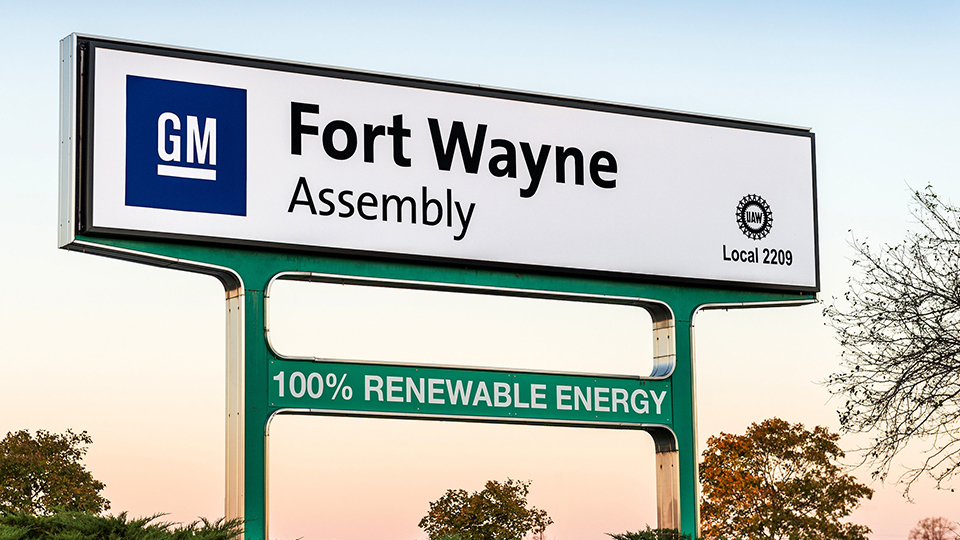
DETROIT, MI (WOWO) — General Motors announced Tuesday that it will take a $1.6 billion charge in its next financial reporting period as it recalibrates its electric vehicle (EV) strategy in light of U.S. policy shifts.
The charge stems from the recent elimination of federal EV tax credits and the relaxation of emissions regulations — both actions that reduce the incentives for automakers to aggressively pivot toward electric mobility.
What’s Behind the $1.6B Hit
GM’s filing breaks down the move into two major components:
-
$1.2 billion in non-cash impairment charges, reflecting adjustments to its EV capacity and manufacturing footprint.
-
$400 million in contract cancellations and settlement costs tied to prior EV-related investments.
GM also warns that more charges could come as it continues to reassess operations and cash flows under the new environment.
What’s Changing — And What Isn’t
Even as GM scales back some EV ambitions, it insists that existing production lines for Chevrolet, GMC, and Cadillac EV models will remain unaffected.
Still, this marks a significant reversal: GM had previously laid out plans to become fully electric by 2035 and achieve carbon neutrality soon after.
Instead of doubling down, the company will now reevaluate where and how aggressively it invests in EV infrastructure.
Industry Snapback & Policy Stress
GM’s move reflects mounting pressure across the U.S. auto sector as government support wavers. The $7,500 EV tax credit that had spurred sales is now gone, and emissions oversight is loosening — making it harder to justify large EV capital outlays.
In response, automakers are rethinking strategy: scaling back production, delaying model launches, or even expanding in internal combustion engine (ICE) and hybrid architectures.
At the same time, global EV competitors — especially in China — are still backed by strong state support, putting U.S. firms at risk of falling behind. Market & Investor Reaction
Following the announcement, GM shares dropped nearly 2–2.5% in pre-market trading.
Analysts say the shift could force GM to rework earnings forecasts, reallocate capital, and rethink its EV ambitions midstream — a challenging pivot in a capital-intensive industry.
What to Watch Next
-
Whether GM issues further impairment charges as the EV environment evolves.
-
Strategic decisions on which plants and models to prioritize going forward.
-
How VR and ICE investments will balance in GM’s portfolio.
-
Broader industry reactions — whether other automakers follow suit.
-
Government responses or new policies that may restore or reshape EV incentives.
