

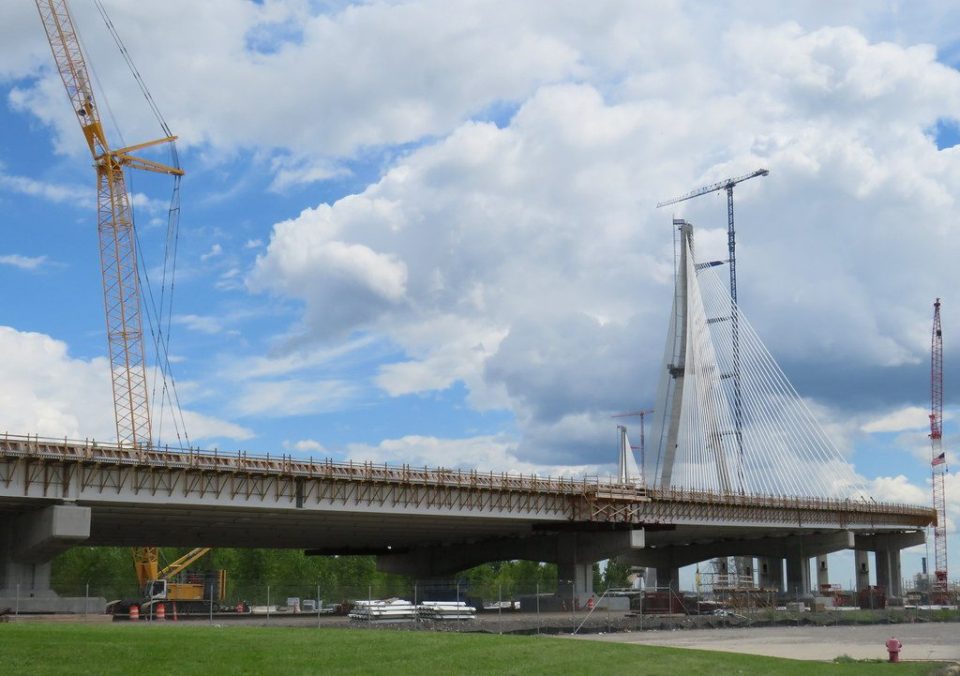
DETROIT, MI (WOWO) The opening of the Gordie Howe International Bridge is expected to bring new opportunities for trade, manufacturing and economic development across northwest Ohio, with regional leaders saying the six-lane crossing could strengthen the area’s role as a major North American transportation hub.
The bridge, scheduled to open to vehicle traffic Monday, creates a second major commercial connection between Detroit and Windsor, Ontario, adding capacity to one of the busiest trade corridors between the United States and Canada.
While the bridge is located in the Detroit-Windsor region, business leaders in Toledo and northwest Ohio say the impact could extend throughout the region by improving freight movement, strengthening supply chains and attracting companies seeking access to both U.S. and Canadian markets.
Brian Dicken, vice president of advocacy and strategic initiatives for the Toledo Regional Chamber of Commerce, said the project is about improving international connections according to WTOL.
“It’s really about our international connectivity,” Dicken said. “It’s about enhancing our trade and our logistics in the region. Canada is our biggest trading partner, and so by having a more efficient, predictable border crossing, we hope to see more international trade coming through here.”
Canada is Ohio’s largest international trading partner, with approximately $40 billion in annual trade between Ohio and Canada supporting thousands of jobs across the state.
Toledo Mayor Wade Kapszukiewicz said many people underestimate how much economic activity already moves through the Detroit-Windsor border crossing.
“The reason it’s a big deal is because Canada is by far Ohio’s largest international trade partner,” Kapszukiewicz said. “Ohio and Canada do about $40 billion of trade every year.”
He said the trade currently moving through the Ambassador Bridge is already comparable to the level of trade between the United States and Japan.
“The trade that takes place over the Ambassador Bridge right now is equal to the amount of trade that the United States does with Japan,” Kapszukiewicz said. “The Gordie Howe Bridge is gonna be bigger, more efficient and would increase trade even more.”
The Gordie Howe International Bridge will provide six lanes of traffic, expanded customs facilities and direct highway connections designed to improve freight movement between the two countries.
For Toledo’s manufacturing sector, regional leaders say a more reliable border crossing could be especially important.
The Toledo region is home to major manufacturers, including Stellantis’ Toledo Assembly Complex, which produces the Jeep Wrangler and Jeep Gladiator.
In a statement, Stellantis said the new bridge will help support its manufacturing operations on both sides of the border.
“The opening of the Gordie Howe International Bridge strengthens the single most important border crossing in North America,” the company said. “As a company with historic operations on both sides of the U.S.-Canada border, Stellantis recognizes the importance of efficient, reliable cross-border infrastructure in supporting our employees, suppliers and customers.”
The automaker said the additional crossing will support just-in-time manufacturing operations by improving the movement of goods between facilities in the United States and Canada.
For automotive companies, delays at the border can create major disruptions because plants often rely on parts arriving shortly before they are needed on assembly lines.
Tony Totty, president of UAW Local 14, said workers saw the impact of supply chain problems during the semiconductor shortage.
“Well, it brings the supply chains closer,” Totty said. “We prefer the supply chain out of Canada than we do out of Asia. We saw that with the chip shortage. You know, we were dead in the water, and it led to layoffs for our members.”
Totty said reliable transportation routes are critical for keeping manufacturing operations running.
“If we’re not going to make it, Canada is the next best option,” he said.
Dicken said manufacturers should benefit from fewer delays.
“A lot of manufacturers depend on that just-in-time inventory, so there’s gonna be fewer delays expected,” he said.
The potential benefits extend beyond automotive manufacturing.
Joe Cappel, vice president of business development for the Toledo-Lucas County Port Authority, said industries including agriculture, energy, chemicals, equipment manufacturing, plastics, rubber, minerals and metals could all benefit from improved cross-border transportation.
“Agricultural could certainly benefit,” Cappel said. “We move a lot of grain shipments back and forth with Canada, both on the water and on our roadways.”
He said the bridge’s expanded customs facilities were designed to handle different types of freight, including hazardous materials and commercial shipments.
“The design of the new bridge has a lot of different lanes for hazmat cargo for regular cargo with a lot of customs clearance lanes as well,” Cappel said. “We’ll be able to move a lot more freight in total over the bridge to meet today’s needs, but also the needs of the future.”
Dicken said agricultural businesses could see immediate advantages because delays at border crossings can create costly losses for perishable goods.
“We’ve heard some horror stories that a truckload of produce got to the border at a few minutes after midnight and the inspections were closed,” he said. “So, you know, they lose, they’re going to lose that load.”
Regional leaders also expect the bridge to complement Toledo’s existing transportation assets, including the Port of Toledo.
Cappel said the combination of shipping, rail and highway infrastructure gives the region a competitive advantage.
“We’ll have maritime, we’ll have rail, and now we’ll have a very efficient highway connection with our neighbors in Canada who are also our trading partners,” Cappel said.
Kapszukiewicz said the economic impact could spread throughout the region.
“A rising tide lifts all boats,” he said. “Everything will be assisted in a positive way from the opening of this bridge.”
One of the biggest questions is whether the new crossing will attract additional companies to northwest Ohio.
Cappel said the region’s location along Interstate 75 and the Ohio Turnpike, combined with available development sites, creates a strong pitch for companies looking for strategic locations.
“We have available land that’s prime development along this trade corridor,” Cappel said. “And when you put all those things together, it makes a compelling case for businesses who want to locate somewhere strategically.”
Dicken said Toledo’s location already provides access to a large portion of the North American market.
“Our region right now is already within a day’s drive of 60% of the North American population,” he said. “This just makes our location even better.”
Some economic leaders, however, caution against viewing the bridge as a single solution for regional growth.
Brandon Sehlhorst, president and CEO of the Toledo Metropolitan Area Council of Governments, said the bridge is an important asset but not a guaranteed economic transformation by itself.
“I’m not necessarily convinced yet that it’s the game changer we’ve been waiting for,” Sehlhorst said. “I don’t think there’s any one thing, to be honest with you, that is the game changer that changes this.”
Sehlhorst said long-term economic growth will require continued investment in infrastructure, workforce development and cooperation among public and private organizations.
“It’s not that it’s the Gordie Howe Bridge,” he said. “It’s improving our connections to Columbus. It’s attracting high-growth industries. It’s preparing sites.”
The bridge opening comes amid increased political tension between the United States and Canada following tariff disputes, which led officials to cancel a planned joint ribbon-cutting ceremony.
Despite those disagreements, northwest Ohio leaders say the project represents a long-term investment in regional connectivity.
Totty said the area has many advantages, including skilled workers, transportation infrastructure and natural resources.
“When you think about this region, you have some of the best auto workers in the world, and there’s a lot of opportunity here,” Totty said. “We have a lot of land and fresh water.”
He said the bridge could help position the region for future investment.
For Toledo and northwest Ohio, the expectation is that the Gordie Howe International Bridge will provide opportunities not just on opening day, but for decades through stronger supply chains, expanded manufacturing, new business development and increased trade with Canada.
