

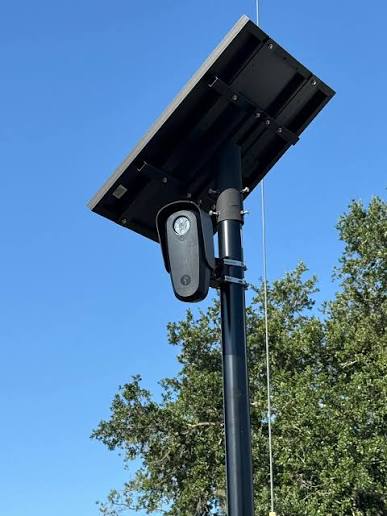
INDIANAPOLIS, Ind. (WOWO) — Indiana lawmakers are preparing to take another look at automated license plate readers as growing concerns over privacy, surveillance and potential misuse put the technology under increased scrutiny.
The cameras have become an increasingly common investigative tool for Indiana law enforcement, but state law currently places few restrictions on how the information they collect can be stored, accessed or shared.
That could change when the Indiana General Assembly returns in January.
The Indiana Capital Chronicle reports that several lawmakers are working on legislation that could establish statewide standards for the use of automated license plate readers, or ALPRs.
Rep. Jim Pressel, R-Rolling Prairie, said the goal is not to eliminate a tool police say has helped solve crimes, but to establish safeguards around its use.
“License plate readers have proven to be a very effective tool for law enforcement,” Pressel said, according to the Indiana Capital Chronicle. “It’s something that I think we need to preserve the good that it does, while at the same time putting up guardrails to protect Hoosiers from surveillance.”
Pressel chairs the House Roads and Transportation Committee and previously authored the provision in House Enrolled Act 1150 that prohibits homeowners associations from using license plate readers to monitor residents and visitors unless the cameras are operated by law enforcement.
That restriction remains the primary state-level limitation on the technology.
Pressel is now working on a broader proposal that could require police departments to conduct routine audits of searches of license plate databases. He said he is also considering annual audits conducted by Indiana State Police.
The legislation could address how long license plate information can be retained and under what circumstances police can share that information with other agencies.
Those questions have become more pressing as the number of license plate readers deployed across Indiana has grown.
Eyes Off Indiana, a group advocating greater restrictions on the technology, estimates that roughly 3,600 automated license plate readers are operating statewide, with cameras located in at least 84 of Indiana’s 92 counties.
The systems are used not only by municipal police departments, but also by organizations and agencies including airport and hospital security, university police, state prisons and conservation officers.
The Indiana Department of Correction uses license plate data in efforts to locate escapees and parolees who may have violated the terms of their supervision. The Indiana Department of Transportation also accesses the information for purposes including tolling operations, construction sites and safety zones.
Police departments say the technology can provide critical leads in investigations.
The Bloomington Police Department, for example, used its license plate reader network to locate a vehicle connected to the rescue of a severely beaten woman from a burning home, according to the city’s public safety report cited by the Indiana Capital Chronicle.
Indianapolis Metropolitan Police Department officials have also credited license plate readers in a number of investigations, including cases involving a serial sexual assault suspect, an alleged multimillion-dollar jewelry theft and efforts to locate missing or vulnerable people.
But the technology’s ability to track where vehicles have been seen has also generated concern among privacy advocates.
Those concerns intensified this month after an investigation by The Washington Post found that an Indianapolis police officer allegedly used the department’s license plate network for personal searches.
The officer reportedly searched for his wife and acquaintances thousands of times over a 10-month period, according to the Post’s investigation.
IMPD suspended the officer and launched an investigation on August 6. Police Chief Tanya Terry recommended that the officer be terminated.
The incident has become a central example for critics who argue that departmental policies alone may not be enough to protect Hoosiers from improper access to license plate information.
Walker Lasbury, a DePauw University student and founder of Eyes Off Indiana, said the absence of a comprehensive state law leaves protections dependent on individual police departments.
“The problem right now is the state of Indiana, (license plate readers) are left completely unregulated,” Lasbury said, according to the Indiana Capital Chronicle. “Meaning that any protections that Hoosiers do have come from departmental policy, and departmental policy can change overnight.”
IMPD said it adopted a new policy this month with stronger language governing access to and auditing of its license plate database.
The department said only officers who have completed training and acknowledged IMPD policies are allowed to access the system.
The department’s Public Affairs Division said in an email that the updated policy emphasizes that automated license plate readers are “powerful investigative tools” that must be used responsibly, legally and only for legitimate public-safety purposes.
The department also said ongoing audits are intended to identify potential misuse and allow supervisors to intervene.
IMPD had not provided the Indiana Capital Chronicle with a copy of the new policy as of Friday.
Indiana State Police already has its own restrictions on database searches. Troopers are required to enter a dispatch or case number each time they search the agency’s license plate database.
District investigative commanders can audit search records at their discretion. ISP spokesman Capt. Ron Galaviz said that safeguard has been in place since the agency began using the technology.
State police policy also prohibits using license plate readers or so-called hot lists to infringe on a person’s First Amendment rights.
The private companies that operate license plate networks are also adding additional safeguards.
Flock Safety, one of the nation’s best-known license plate reader companies, plans to require case codes for law enforcement searches. Agencies using Flock will also be required to adopt an audit-assistance tool designed to flag suspicious activity and temporarily suspend users while an administrator reviews the searches.
Critics nevertheless want the state to go further.
Lasbury is discussing potential legislation with lawmakers that could establish a statewide data-retention limit, prohibit the commercial sale or sharing of license plate information and establish criminal and civil penalties for misuse.
He has suggested a seven-day retention limit for vehicles that do not appear on law enforcement hot lists.
That proposal would be similar to a new default storage limit recommended by Flock Safety.
The issue has also drawn attention from Indiana law enforcement representatives.
The Indianapolis Fraternal Order of Police has called on lawmakers to establish statewide standards governing license plate reader use.
Sen. Aaron Freeman, R-Indianapolis, said lawmakers need to examine the technology comprehensively.
“I tell people all the time: I don’t think we suspended the Fourth Amendment to the Constitution anytime recently, so we should probably look at this topic,” Freeman said, according to the Indiana Capital Chronicle.
Freeman, who previously chaired the Senate Corrections and Criminal Law Committee, said lawmakers need to answer fundamental questions about who can access the information and how long it can be retained.
“Who can have access to this stuff? How long do you keep it?” Freeman asked. “When you’re looking for somebody who’s cheating on their spouse, can you use it for that? Somebody runs for office — can we use it for that?”
Freeman and Pressel are among several lawmakers examining possible legislation, although it remains unclear how many bills will ultimately be introduced when the General Assembly convenes in January.
Gov. Mike Braun’s administration has indicated that the governor is open to additional safeguards.
“Guardrails are important and should be considered anytime personal information is involved,” governor’s office press secretary Griffin Reid said, while also emphasizing Braun’s support for providing law enforcement with resources needed to protect public safety.
Meanwhile, resistance to the technology is emerging in communities outside Indianapolis.
In Lawrence County, a petition calling for a ban on Flock cameras and other automated license plate readers had collected more than 500 signatures by Friday evening.
Organizer Nikki Luallen said she launched the petition after noticing license plate readers appearing throughout the southern Indiana county, which has a population of roughly 45,000.
Luallen said she has identified 16 of the cameras in Lawrence County.
“I don’t want to live in a society where there are cameras on every corner,” Luallen said, according to the Indiana Capital Chronicle.
For Luallen and other opponents, the concern goes beyond individual cameras.
The systems can connect individual sightings to broader databases, potentially allowing authorized users to reconstruct where a vehicle has traveled and share information across jurisdictions.
That nationwide connectivity is one of the primary distinctions critics make between automated license plate readers and conventional private security cameras.
Supporters counter that the cameras do not merely provide broad surveillance; they can give investigators leads in cases involving stolen vehicles, missing people and violent crimes.
That tension is likely to shape the debate at the Statehouse: how Indiana can retain a technology law enforcement considers valuable while establishing limits that prevent it from becoming a tool for improper surveillance.
Pressel said that balance is ultimately what lawmakers are trying to achieve.
“I don’t think anybody wants to see them go away, and we need to preserve the good while protecting Hoosiers from any kind of misuse,” Pressel said, according to the Indiana Capital Chronicle. “That’s the goal, and I think that is going to hit the sweet spot. Time will tell.”
The issue is expected to receive renewed attention when Indiana lawmakers return to the Statehouse in January, with data retention, access, auditing and potential penalties among the issues likely to be debated.
