

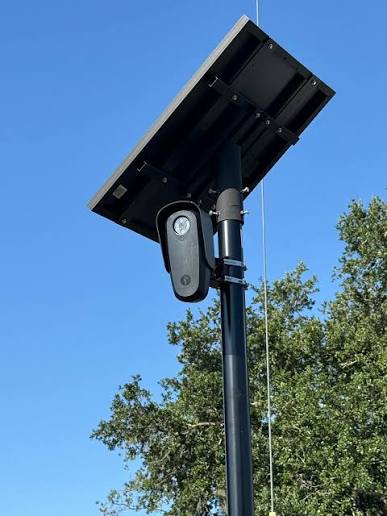
COLUMBUS, Ohio (WOWO) — A bipartisan group of Ohio lawmakers is asking the Ohio Department of Transportation to stop issuing permits for Flock Safety automated license plate readers on state roads and review permits that have already been granted.
State Reps. Tristan Rader, D-Lakewood, Levi Dean, R-Xenia, Darnell Brewer, D-Cleveland, and Justin Pizzulli, R-Scioto County, signed a letter to Ohio Transportation Director Pamela Boratyn calling for the changes.
The lawmakers want ODOT to reject new permit requests for Flock cameras and other similar license plate-reading technology placed within state rights of way.
They also want the agency to review existing permits and, where legally authorized, revoke those permits and have the cameras removed.
The lawmakers are additionally asking ODOT to make public how many automated license plate readers it has authorized, who owns the cameras and the terms of the agreements connected to them.
The effort comes amid increasing scrutiny of Flock’s technology in Ohio and across the country, with supporters pointing to its use in criminal investigations and critics raising concerns about privacy, data retention and the potential for widespread tracking.
Flock Safety operates automated license plate readers that capture information about passing vehicles. The company says its cameras focus on vehicle information such as license plates, make, model, color and other characteristics rather than recording people inside vehicles.
Flock says its technology is used in thousands of communities nationwide and has supported law enforcement investigations involving crimes ranging from theft to human trafficking.
The company has said its technology supported more than one million investigations in 2025.
Critics, however, say the growing number of cameras creates the potential for law enforcement and other authorized users to reconstruct people’s movements over time, raising questions about how long information should be retained, who can access it and when searches should require a warrant.
The Ohio lawmakers’ letter argues that public roads should not become the foundation for what they characterize as a privately operated surveillance network without stronger public oversight.
“The public right-of-way should not become free real estate for an unaccountable, privately operated surveillance network,” the lawmakers wrote.
The lawmakers are also calling for clearer statewide policies governing how license plate data is searched, retained and shared.
Dean separately plans to introduce legislation that would prohibit agencies from accessing Flock camera information without a warrant.
The dispute comes as Ohio communities the time, Ginther cited cases in which the technology helped Columbus police investigate a homicide and a nonfatal shooting and locate take different approaches to the technology.
Columbus Mayor Andrew Ginther announced Aug. 28 that the city was establishing a stronger framework and independent oversight for its Flock system.
At the time, Ginther cited cases in which the technology helped Columbus police investigate a homicide and a nonfatal shooting and locate a missing senior and a kidnapped child.
“This should not be a choice between protecting civil liberties and protecting people from violent crime,” Ginther said. “Columbus can and should demand both.”
Less than a week later, however, Ginther announced that Columbus was suspending its use of the cameras.
The change followed a USA Today investigation examining searches conducted through the system. The investigation found that Columbus police Officer Melvin Tellis searched the same license plate 272 times between November 2023 and December 2024.
Ginther saidocratic gubernatorial candidate Amy Acton has called for tighter restrictions on the technology after previously highlighting he could not ask residents to trust the technology until the city determined whether the incident represented a broader problem.
Tellis was relieved of duty while the city investigates his use of the camera system, according to reporting cited by the Ohio Capital Journal.
Other Ohio communities also have been reassessing their use of Flock cameras.
The growing debate has moved beyond local government and into statewide politics.
Democratic gubernatorial candidate Amy Acton has called for tighter restrictions on the technology after previously highlighting its usefulness in fighting crime.
Acton has said AI-powered Flock cameras present privacy risks and has backed the bipartisan lawmakers’ effort to stop new permits on state highways.
Her campaign has also said she would support legislation addressing the use of Flock technology statewide.
Republican gubernatorial candidate Vivek Ramaswamy has said he has been communicating with Ohio law enforcement about the technology and has emphasized the need to balance crime enforcement with constitutional protections.
Speaking in Lima last month, Ramaswamy said Flock cameras should not be used to monitor people in private spaces.
The distinction between what the cameras actually capture and how the resulting information can be used is at the center of much of the current debate.
Flock cameras generally capture vehicle and license plate information as vehicles pass the cameras. The concern raised by critics is what can happen after that information enters a searchable database.
The Ohio Capital Journal reports that Ohio currently lacks a comprehensive statewide policy governing how this traffic data is searched, retained or shared.
The lawmakers say that gap is reason enough for ODOT to pause further permits while the state determines what safeguards should be in place.
Their letter points to Florida, where transportation officials recently took steps to revoke permits for similar cameras.
“Ohioans deserve the same protection,” the lawmakers wrote.
The lawmakers said the debate is not simply about whether license automated license plate readers can provide investigators with leads after crimes occur and help locate missing people, stolen vehicles and plate readers can help police solve individual crimes.
“The question is whether that benefit justifies building a system capable of tracking millions of innocent Ohioans without a warrant, individualized suspicion, or meaningful public oversight,” they wrote.
The issue also comes as the number of Flock cameras operating in Ohio continues to grow.
The Ohio Capital Journal cited an open-source database maintained by the advocacy group DeFlock that lists more than 8,000 Flock cameras in Ohio communities. The database is not an official state inventory.
Supporters of the technology argue automated license plate readers can provide investigators with leads after crimes occur and help locate missing people, stolen vehicles and suspects.
Opponents say those benefits need to be weighed against the possibility that information collected from people who have done nothing wrong can be retained and searched.
For now, the bipartisan lawmakers are asking ODOT to take action within its existing authority while also pushing for broader legislation.
“Our roads belong to the public,” Rader, Dean, Brewer and Pizzulli wrote. “They should not be used to quietly construct a statewide tracking network around the public.”
ODOT has not, in the material reviewed for this report, announced a statewide suspension of Flock permits in response to the lawmakers’ request. The letter instead represents a bipartisan request for the agency to stop new permits, examine existing ones and provide greater transparency about the camera network.
