

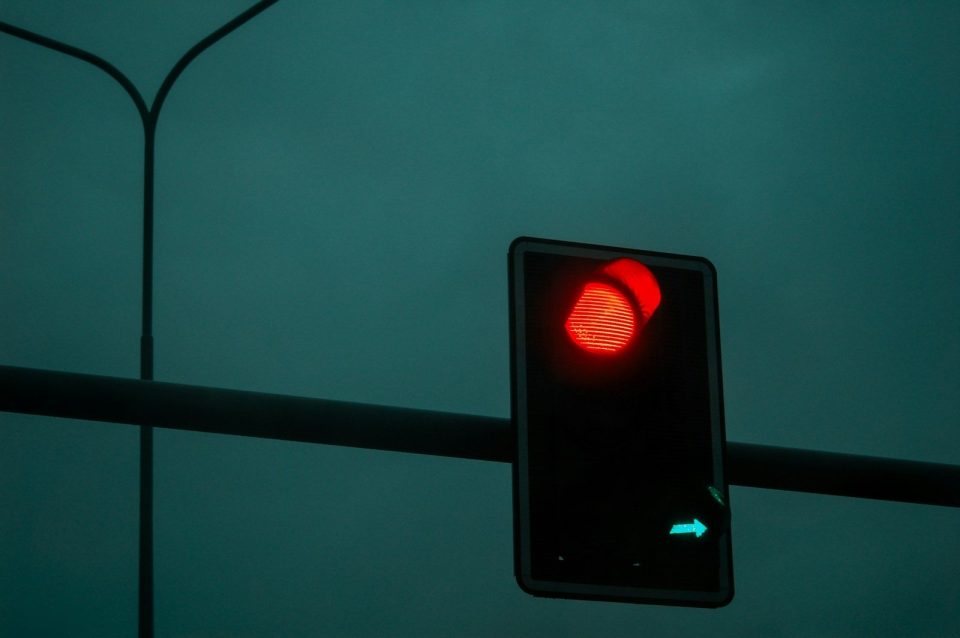
INDIANAPOLIS, Ind. (WOWO) — If you have ever sat through what feels like an endless red light with no cross traffic in sight, there may be a simple explanation: The traffic signal may not have detected your vehicle.
Traffic lights are controlled in several different ways, and while some operate on timed cycles, others use sensors to determine when vehicles are waiting at an intersection.
That means where you stop can matter.
One of the most common types of traffic detection is an induction loop buried underneath the pavement. Drivers can sometimes spot the loops because they appear as rectangular cuts or lines in the pavement near the stop line.
The Neenah, Wisconsin, Public Works Department explains that an induction loop is essentially a coil of wire installed underneath the roadway. When a large metal object, such as a vehicle, sits over the loop, it changes the loop’s magnetic field.
That change can tell the traffic signal that a vehicle is waiting.
If your vehicle is not positioned over the detection area, however, the signal may not recognize that anyone is there.
For most drivers, the simplest step is to pull forward to the solid white stop line rather than stopping several feet behind it.
Smaller vehicles can present a particular challenge because they contain less metal and may not interact with an induction loop in the same way as a larger vehicle.
Neenah Public Works recommends that motorcycle, bicycle and moped riders position their tires directly over the pavement markings associated with the sensor.
Other intersections use magnetic detectors or magnetometers. The Federal Highway Administration says these systems also detect changes in a magnetic field caused by vehicles.
The same basic principle applies: The vehicle needs to be in the appropriate detection area.
Not every traffic light relies on sensors buried underneath the pavement.
Some intersections use equipment mounted above or alongside the roadway.
Infrared sensors can detect a vehicle when it interrupts a beam of light or when the system detects heat associated with a vehicle.
Cameras can also be used to monitor traffic. Those systems may feed information into a larger network that adjusts traffic signals based on traffic conditions.
Some intersections use several types of detection equipment at the same time.
Los Angeles, for example, has used a traffic-management system incorporating magnetic sensors, cameras and a centralized computer network to help coordinate thousands of traffic signals.
Other intersections may operate on predetermined timing rather than responding to vehicles.
That can happen around major event venues, where traffic patterns are predictable during games, concerts or other large gatherings.
In those situations, a driver may have little ability to change the timing of the signal.
If you are sitting at a signal that appears not to recognize your vehicle, there are a few things drivers may be tempted to try.
Flashing your high beams can sometimes activate certain types of traffic equipment, although it is not a universal solution.
Hitting the horn, however, will not normally trigger a vehicle detector. Traffic sensors are designed to detect vehicles or traffic conditions, not sounds.
The most important advice is to avoid running the red light simply because the signal appears to be stuck.
Instead, drivers should follow the traffic laws applicable in their jurisdiction and look for a legal and safe alternative.
Depending on the intersection and local law, that could mean waiting for the signal, making a legal right turn and finding another route, or otherwise leaving the intersection safely.
Left-turn signals can create another common problem.
If a protected left-turn arrow does not appear to be changing, drivers should not assume they are automatically allowed to turn against a red signal.
Rules vary by state and situation.
California Highway Patrol Officer Dan Olivas previously told the Press-Telegram that drivers who believe a signal is malfunctioning should prioritize safety and be prepared to explain the circumstances to law enforcement if they are stopped.
The safest approach is to make sure your vehicle is properly positioned over the apparent detection area, remain patient and avoid making a dangerous or illegal maneuver simply because the light has taken longer than expected.
For drivers, the next time a red light seems to be ignoring you, check where your vehicle is positioned before assuming the signal itself is broken.
